The following article was written for a Culturala Journal issue on Memory. Unfortunately the journal closed down before it was published.
…the surest engagement with memory lies in its perpetual irresolution.
(James E. Young)
Memory is more than an imagined past – it is the very fabric of the present. Our memories accumulate across time and space into the singular entity that we are in any given moment. Individually, and collectively, we are the sum of our pasts.
Typically, groups and nations commemorate their pasts through public monuments that mark specific events or honour specific people. These monuments tend to tell a rather one-sided story, valorising the narrative of the state, or of the dominant social group, at the expense of many realities. Monuments become mere objects that do more to legitimise the state than they do to honour memory. Scholar James E. Young, for example, says that public monuments ‘tend to naturalise the values, ideals, and laws of the land itself. To do otherwise would be to undermine the very foundations of national legitimacy, of the state's seemingly natural right to exist.’ This creates a skewed narrative which excludes a great deal. When a nation denies a part of its history, because it is perhaps too painful, too complicated, too messy, when it renounces key memories in favour of an easy narrative, it denies the lived reality of many of its inhabitants.
There is a curious quality to the public monument which makes the very memories they claim to preserve invisible. Young writes that ‘[i]nstead of searing memory into public consciousness… conventional memorials seal memory off from awareness altogether.’ The reason for this disconnect lies in the very nature of memory itself. When we remember, we bring the past into the present, and understand it through the referrants and realities of today. Monuments fail and lose meaning when they cease to be relevant to the now. After all, monuments are static pieces of matter. And as such, they become stuck in time and cease to mean much to anyone in the present. Most monuments tend to disappear into the cityscape, becoming empty objects, referring only to themselves.
Where monuments and official narratives fail, art practices can encourage a much more dynamic relationship with the past. The key difference is that artworks tackling memories use the referrants of today to engage with the past, pulling memory into the now, and demanding a more thorough engagement. Art can also provide a mechanism for engaging with those narratives that are not recognised by the state or nation: narratives of oppression, of violence, of suffering at the hands of the state itself.
An example of commemoration through art is Irish performance artist Amanda Coogan’s Yellow, first performed in 2008. The performance and resulting video ask us to bear witness to the past, to share in our sisters’ pain, and to recognise our own complicity in the suffering of our neighbour.
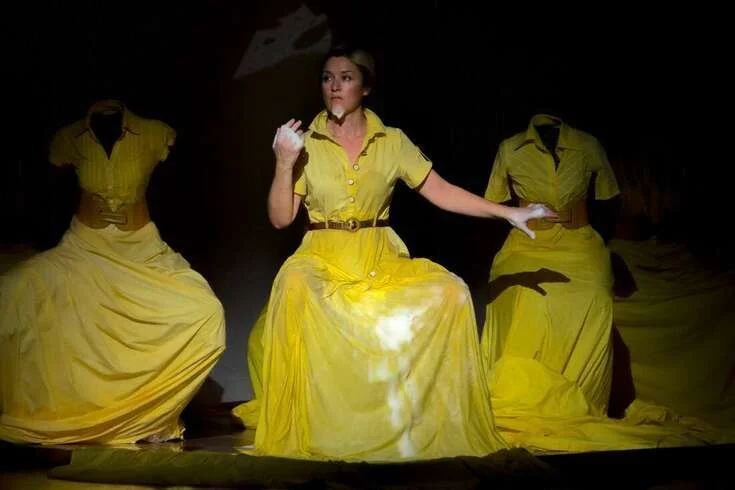
The artist sits, back straight, perched on top of a large bucket of soapy water. With two hands, she submerges the yellow fabric of her dress in the bucket, pulls it out and scrubs vigorously, dense suds forming in her hands. Over the course of four hours, the artist scrubs, regularly raising her eyes to meet her audience, holding each viewer in her gaze for a moment.
In an Irish context, these cycles of scrubbing recall the fate of countless women who were incarcerated in abusive institutions across the country throughout the 20th century. The Magdalene Laundries were forced-labour institutions run by the Catholic Church in collusion with the Irish state. Women were imprisoned for any number of perceived transgressions, including being a single mother, being ‘promiscuous,’ or simply being disobedient. Women outside of the ‘norm’ were routinely incarcerated in these institutions. where they were abused both physically and emotionally, and worked from morning to night, washing laundry for the local communities, churches, and state bodies. On top of the unimaginable suffering inflicted by these institutions, the deafening silence in the years since on the part of both the church and state has caused immeasurable pain.
In Yellow, Coogan makes visible the lived reality of the women enclosed behind the doors of the Laundries, their stories ignored and untold for so many years. The artist’s insistence on making eye contact with her audience highlights our own complicity in the suffering of others, demanding that we remember and acknowledge our dark past.
Another notable piece is the work of Colombian artist Doris Salcedo, which foregrounds the intimate traces left behind by violence around the world. Her installation Noviembre 6 y 7 is a testament to the lives lost during the violent siege of the Palace of Justice in Bogota in 1985.
On the morning of November 6th, 1985, an attack was launched by a guerilla group on the Palace Of Justice in Bogota (home to Colombia's Supreme Court and Judicial Council). Civil servants and civilians were held hostage within the building. The Colombian military responded quickly and aggressively, refusing to negotiate with the guerilla fighters, opting instead to launch a full-force attack with tanks and armed forces to retake the palace. Over the course of 2 days, the palace was completely destroyed. The number of lives lost is disputed with the higher estimate being 280. Victims included guerillas, civilians, and Supreme Court Justices. The siege has been commemorated sporadically by the state in the form of memorials, which often obscure the reality of the state’s hand in the deaths and disappearances of many. Families of victims have been calling for further investigation into what happened at the Palace of Justice, and it is only in the last decade that investigation has begun to reveal what truly occurred.
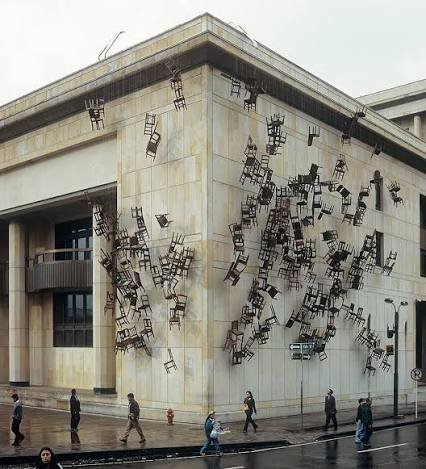
Salcedo’s Noviembre 6 y 7, staged in 2002, marked the 17th anniversary of the siege. Over the course of 52 hours (directly corresponding to the length of the siege), 280 wooden chairs were lowered, one by one, over the outer walls of the reconstructed Palace of Justice. One chair for each life lost. The destruction and rebuilding of the palace has resulted in a site divorced from the shocking violence that took place there – a tabula rasa that allows for an easy and willful forgetting of events. Salcedo reclaims the building, re-inscribing it with the physical loss of each individual life. By marking the site in this way, the palace is no longer a passive site, becoming instead an active space within the city which impresses itself upon the urban environment and its inhabitants. Passers-by are pulled first into recognition, and then into memory of those who died and disappeared, and of the state’s hand in it all.
Finally, we turn to Indian artist Nalini Malani, whose practice explores memory as a phenomenon which is both fallible and multiplicitous. Malani’s works explore narratives both past and present, where memory and history come together to form a global narrative that demands careful consideration. Through sustained engagement the viewer becomes instrumental in the work, as their memories blend with Malani’s, India’s, Pakistan’s, and the wider world’s.
When Malani was one year old, the partition of India and the Muslim-Hindu violence that followed forced her and her family to flee Karachi (now Pakistan) and relocate to Mumbai. From an early age, her life was shaped by ghostly memories of violence and loss: ‘I have no direct experience of Partition. It’s more the atmosphere that my mother and my grandparents lived with, the sense of loss – loss of culture and community, loss of language, loss of food.’ Monuments to the partition are scant, and most of the work of remembering has been done by artists and independent groups.
Only in 2021 did the Indian government finally begin official commemoration with the Partition Horrors Remembrance Day, held on August 14th. The cycles of violence that emerged from partition continue to this day and inform Malani’s practice. Her aim is never to simply remember lives lost or lament ‘past injustice’; her work goes beyond merely remembering or lamenting and aims to demonstrate what Malani sees as the ‘repetitive cycles of violence in the present.’
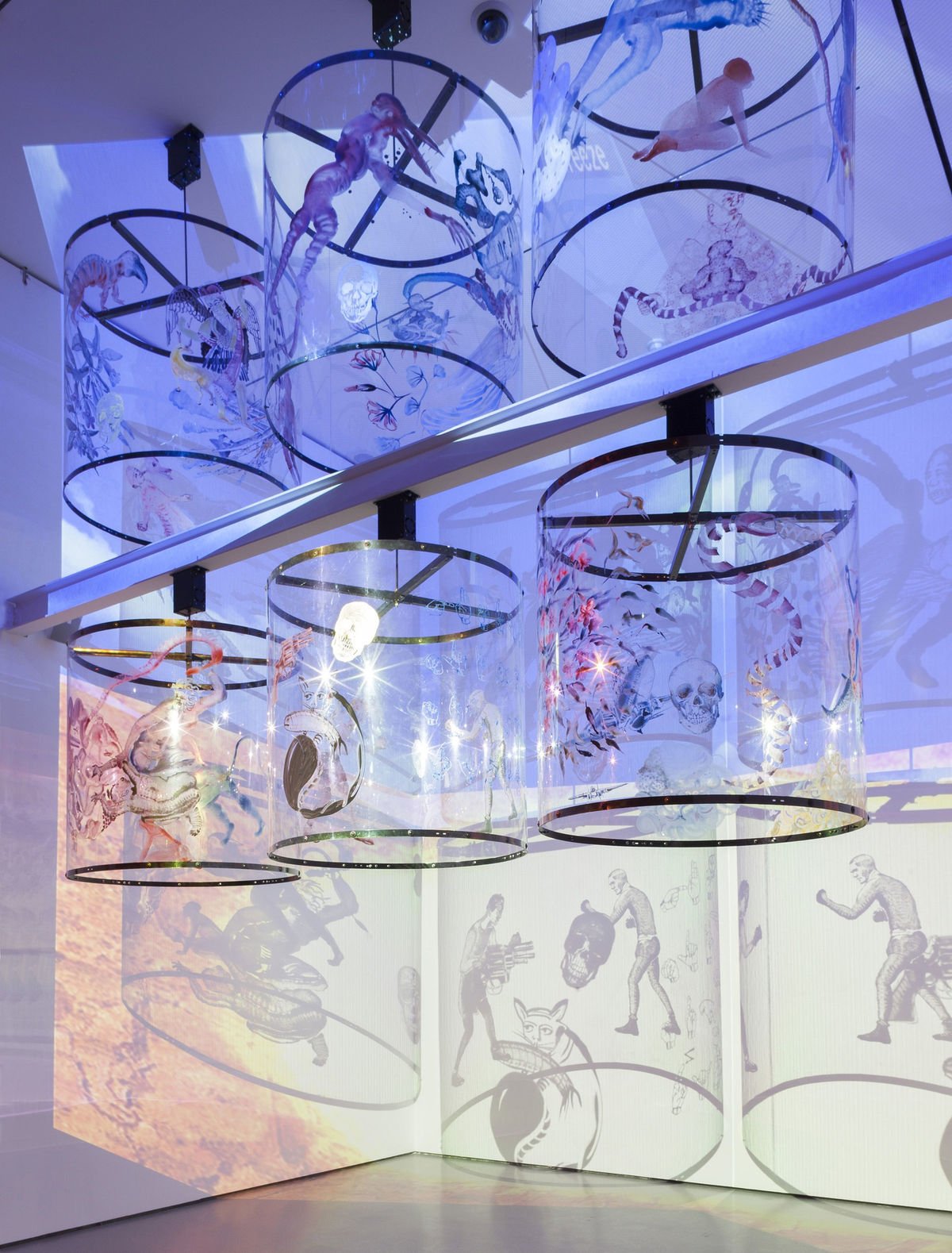
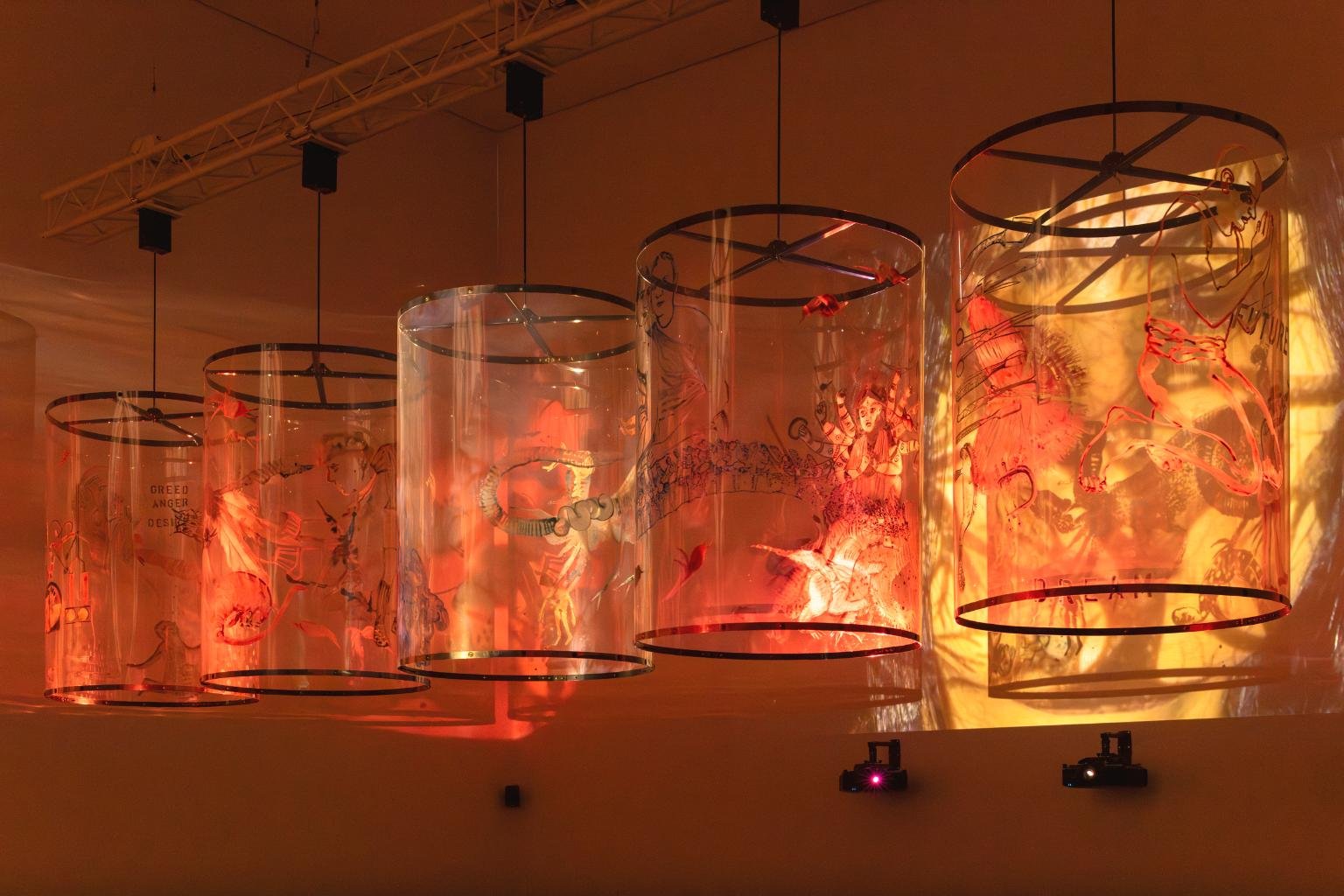
In In Search of Vanished Blood (2012), Malani uses shadow play, drawing, video, and voice to create a layered and immersive experience which at once stimulates personal memory, and is suggestive of memory itself. The work is an installation, consisting of five transparent Mylar cylinders marked with drawings of mythological creatures and figures drawn from the artist’s memory. Six different films are projected over, through, and on top of these cylinders. The work draws on multiple sources, including Greek and Hindu mythologies, as well as footage of conflicts from around the world, to explore the seemingly endless cycles of violence against women globally. The shadows of the drawings on the Mylar cylinders interplay with the images in the films, creating layers of possible meanings.
In Malani’s work, the shadow refers to everything that is forgotten. The shadow is the absent object, the hazy memory, the disputed history. At the same time, the shadows cast by viewers themselves implicate them in the complicated narratives unfolding. Viewing is itself an act of memory, as our minds make associations in order to produce meaning. As viewers engage with the complex layers of narrative in Malani’s work, repeated instances of memory triggered by the simple act of comprehension implicate them further and further.
From a theoretical perspective, ideas of memory are based on French historian Pierre Nora’s work – in particular, his essay “Between Memory and History.” Here, he explicates a key difference between the concepts of memory and history: “Memory is a perpetually actual phenomenon, a bond tying us to the eternal present; history is a representation of the past”. In this opposition of memory and history, we can think of the contemporary art practices discussed as acts of memory, and monuments – representations of the past from a singular, dominant perspective – as acts of history.
Art allows us to connect with memories of our shared past, memories that may not be directly our own, and understand ourselves as part of a collective. In the works of Coogan, Salcedo and Malani, we see an embrace of the past within the present, and a foregrounding of the narratives of marginalised and oppressed groups. By shining a light on forgotten narratives, by implicating ourselves in our collective pasts, we can embrace the fullness of our stories, both as nations and as individuals. From here, we can walk more confidently into a future of our own creation.